


Introduction
Nurses perform the crucial role of maintaining or promoting peoples’ health; therefore, they must maintain good personal health themselves. Several studies have reported that nurses’ poor mental health status is associated with occasional medical errors, raising concerns about patient safety [1, 2]. Nursing-a human service occupation involves a high mental health risk [3]; in fact, low levels of nurses’ mental health status have been reported in many studies [4, 5].
As a predictor of nurses’ mental health, high job-stress significantly deteriorates their mental health. Job-stress includes role workload, role insufficiency, role ambiguity, role limit, responsibility, physical environment [6], high psychological job demands, low job control [7], and low job support [8, 9]. However, nurses’ mental health status is not affected by job-related stress alone. A South-African study [10] revealed that personal stress, including family-related stress, better predicts nurses’ mental health status than their job stress. Additionally, in Japan, Okada et al. [11] reported that nurses with a child indicated lower levels of mental health than nurses without children this might be attributable to family demand. The most representative and investigated stress factor related to job and family is the concept of work–family conflict, which arises from competing responsibilities toward work and family. It comprises work interference with family and family interference with work [12, 13], and negatively impacts nurses’ mental health [14, 15].
The burden of family demands varies among nurses of different ages: young nurses aged 30–40 years are often responsible for caring for their children, whereas nurses aged over 50 do not require long periods for childcare. At Present, nurses work in a range of healthcare settings, such as public health, home healthcare, or as nursing residents [16]. Most graduated nurses’ primary workplace are hospitals; however, as home healthcare nurses are required to have significant nursing experience [17], their mean age is more than that of hospital nurses. Moreover, several nurses who previously worked in hospitals find employment at nursing homes [18]; therefore, nursing home nurses tend to be older than their hospital counterparts. Nurses’ age variations among different healthcare settings may explain the differences in their family-related stress levels.
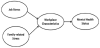
The purpose of this study is to clarify the impact and magnitude of both job- and family-related stress on nurses’ mental health status, and identify whether nurses’ factors affecting mental health vary according to workplace (Figure 1).
Materials & Methods
Design and setting
This study applied a cross-sectional design. The data were collected through self-report questionnaire completed by nurses in hospitals, home healthcare facilities, and nursing homes in Kyusyu district, Japan. The data were collected from October 1, 2013–October 26, 2014.
In Japan, approximately 70% of nurses work in hospitals- significantly exceeding the proportion of their counterparts in home healthcare facilities and nursing homes. As an equal sample was required for comparing each workplace: hospital, home healthcare facility, and nursing home, we randomly selected 32 hospitals in the target district and requested the nurses to participate in the survey. Thereafter, we requested all 672 home healthcare facilities and all 1,507 nursing homes in the target area to participate in the survey. Consent was received from nine hospitals (agreement rate, 32%), 86 home healthcare facilities (agreement rate, 0.13%), and 107 nursing homes (agreement rate, 0.07%).
The survey procedure was as follows: first, each target organization’s representative consent for the survey was confirmed; second, questionnaire packs including the explanation of the study purpose and questionnaire were delivered to target nurses. Finally, completed questionnaires were returned by mail individually by participants or by the participating institution.
Ethical Consideration
Participating organizations signed an agreement declaring their consent for the study; individual participants’ consent was confirmed when they submitted completed questionnaires. To ensure participants’ privacy, questionnaires were anonymous and placed within envelops. This study was approved by the ethics committee of the University of Kyushu (No. 25-160, Date: 13/9/2013).
Sample
A total of 2177 questionnaires were delivered, and 1788 were returned (return rate: 82%). A total of 1,461 completed questionnaires were analyzed: 596 from hospital nurses, 408 from home healthcare nurses, and 457 from nursing home nurses. Inclusion criteria: full- or part-time nurses working during the survey period; exclusion criteria: nurses who quit their workplace during the survey period.
Measures
Job stress
We measured participants’ level of job stress using the Japanese version of the Job Content Questionnaire, which is based on the theory of the job-demand-control-support model [19]. This model is widely applied to research on the mental health of nurses and/or employees [20, 21]. The original questionnaire is in English; the Japanese version was created by Dr Kawakami [22].
The questionnaire comprised 22 items covering three subscales: job demand, job control, and job support. Participants responded used a 4-point scale (1 = strongly disagree, 4 = strongly agree). Job demand refers to the job’s psychological demands; sample items include, “My job requires me to work very fast,” and “I am free from conflicting demands made by others” (reverse-coded item). Job control implies skill discretion and decision autonomy, and measured items include, “My job requires that I learn new things” (skill discretion) and “My job allows me to make a lot of decisions on my own” (decision autonomy). Job support, that is, support from coworkers and supervisors, is measured using items such as, “People I work with take a personal interest in me” (coworker support) and “My supervisor is concerned about the welfare of those working under him” (supervisor support). Cronbach ’s α were 0.67, 0.68, and 0.89 for job demand, job control, and job support, respectively in this study.
Family-related stress
Work–family culture, family stress, and work–family conflict was measured as family-related stress variables in this study.
Work–family culture : As work–family culture, the level of target nurses’ perception about their organizations’ understanding regarding their family role was measured, using one item: “Your organization understands your family role.” Responses used a 4-point scale (1 = there is no understanding, 4 = there is understanding). Higher scores signified participants’ stronger belief that their organizations understood their family role.
Family stress: As family stress, the frequency of feeling stress related to family members was assessed. One item was used: “Do you feel stress when you are with your family?” Responses used a 3-point scale (0 = never, 2 = always); a higher score indicated that the target nurses felt stronger family-related stress.
Work–family conflict : The target nurses’ level of work–family conflict was measured using the Japanese version of the multi- dimensional Work-Family Conflict Scale [23]; the original version of this scale is in English [24]. This scale was widely used to measure Japanese nurses’ level of work–family conflict [25, 26], It comprises 18 items encompassing two dimensions: work interference with family (9 items); and family interference with work (9 items). Sample items include: “My work keeps me from my family activities more than I would like” (work interference with family), and “The time I spend on family responsibilities often interferes with my work responsibilities” (family interference with work). Responses used a 5-point scale (1 = strongly disagree, 5 = strongly agree). Higher scores indicated greater work–family conflict. The Cronbach’s α score of this study were 0.89 and 0.87 for work interference with family and family interference with work, respectively.
Mental health status
The Japanese version of the General Health Questionnaire-12 (GHQ-12) [27] was applied for assessing participants’ mental health status; the original version of this scale is in English [28]. The Japanese version of GHQ-12, which has been widely used [29, 30], comprises 12 items; one sample item states, “I feel stress more than usual,” with responses selected from 4 options (1 = never, 2 = rarely, 3 = sometimes, 4 = often). In this study, the GHQ scoring system was applied, wherein the answers 1 (never) and 2 (rarely) were equivalent to a score of 0, whereas answers 3 (sometimes) and 4 (often) equaled 1. Thereafter, each participant’s GHQ score was summed up, ranging from 0 to 12 [31]; higher scores indicated participants’ poor mental health status. Cronbach’s α was 0.81 in this study.
Characteristics of nurses
We targeted nurses’ age, job tenure, qualification (e.g., registered nurse, enrolled nurse), working style, childrearing role, and whether living with family.
Analysis
Hierarchal regression analysis was conducted to identify variables affecting the GHQ-12 score. In the first regression analysis, individual variables were job stress variables of job demand, job control, and job support. The next regression analysis of independent variables was of family-related variables including work–family culture, family stress, work interference with family, and family interference with work. In the final analysis, independent variables included both job- and family-related stress variables. Subsequently, the participating nurses were divided into three groups: hospital, home healthcare, and nursing home, and thereafter, repeatedly conducted the abovementioned analysis to examine the differences in the factors affecting each workplace.
All statistical analyses were performed using the Japanese version of SPSS for Windows 24. We verified our sample’s statistical adequacy by conducting post-hoc examination, using G*Power 3. The statistical analyses showed a significance of p <.05.
Results
Summary of target nurses
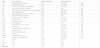
A total of 1,461 nurses completed the survey: 596 hospital nurses, 408 home healthcare nurses, and 457 nursing home nurses. Their mean age was 43.3 years (±10.6), and hospital nurses were younger than home healthcare and nursing home nurses. Furthermore, more part-time nurses worked in home healthcare than in hospitals and nursing homes, and more enrolled nurses worked in nursing homes than in hospitals or home healthcare (Table 1). The mean (±SD) score of job-or-family stress variables and the GHQ, and the correlations between measured stress variables and GHQ scores, are shown in variables were significantly related to the GHQ scores.
Job-or-family stress variables affecting the GHQ score of all nurses
All measured job-or-family stress variables significantly related to the total GHQ score for all participants, and job and family stress variables showed similar coefficients of determination (job stress variables, adjusted R2 =.193; family-related stress variables, adjusted R2 =.196). Job demand, family stress, work interference with family, and family interference with work were significantly and positively related to nurses’ GHQ scores. In contrast, job control, job support, and work-family culture were significantly negatively associated with nurses’ GHQ scores. The strongest prediction was job demand (β =.211, p <.000, R2 =.272, ES: f2 = 1.6103, (1 - β) = 1.0000), followed f2 by job control (β = -.153, p <.000, R 2 =.272, ES: = 1.6103, (1 - β) = 1.0000) (Table 3).
Variables affecting GHQ score for hospital, home healthcare, and nursing home nurses
Regarding hospital nurses, neither work–family culture nor family stress was significantly related to GHQ scores, and family interference with work did not predict nursing home nurses’ GHQ scores. Notably, home healthcare nurses showed a unique relationship between their job-or-family stress variables and their GHQ scores. The determined coefficient of family-related stress variables was larger than for job stress variables (family-related stress variables, adjusted R2 =.270; job stress variables; adjusted R2 =.110), and their strongest predictor was family stress (β =.220, p <.000, adjusted R2 =.279, ES: f2 = 2.1907, (1 - β) = 1.0000). However, the job stress variables of job control and job support were not significantly related to home healthcare nurses’ GHQ scores (Table 4).
Discussion
Affecting factors of nurses’ mental health status
For the entire group of participants, all measured job- or family- related stress variables showed significant correlation to their mental health status. In job stress, job demand was positively related and job control or job support were negatively related to target nurses’ mental health status-findings were consistent with those of previous studies [32, 33]. This result support the theory of the job-demand-control- support model.
Similar to job stress, family-related stress variables were also significantly related to nurses’ mental health. In terms of work–family conflict, results indicate that both work interference with family and family interference with work were impediments to nurses’ healthy mental status, consistent with extant research [34, 35]. Contribution ratios of job- and family-related stress were similar. However, the final regression analysis showed that the most impactful factor was job demand, followed by job control. This indicates that nurses’ mental health status can be predicted by their job status.
Differences among nurses in hospitals, home healthcare, and nursing homes
In terms of workplace, the nurses indicated different results of factors affecting their mental health status. Regarding job stress, unlike hospitals and nursing home nurses, home healthcare nurses showed interesting results. Home healthcare nurses’ mental health was not affected by job control and job support; additionally, the power of job demand was insignificant. Neel-Boylan [36] had highlighted the difference between institutional nursing (e.g., hospitals or nursing homes) and home healthcare nursing; this difference is attributed to the different work environment and nursing characteristics. Home healthcare nurses, basically, work alone and value their autonomy [36, 37]; they enjoy significant control over decision-making in patient-care. This is a possible reason why job control or job support did not appear to impact the mental health of home healthcare nurses.
This work characteristic also could explain why job stress had a weak effect on the mental health status of home healthcare nurses.
Regarding family-related stress, hospital nurses, home healthcare nurses, and nursing home nurses showed varied results. Work– family culture and family stress were not indicated as having affected hospital nurses’ mental health, whereas, for home healthcare nurses, the family-related stress variables had the greatest magnitude of influence among the mental health status variables. In Japan, nurses who prioritize work–life balance tend to prefer working as home healthcare nurses [38, 39]. In this study, many home healthcare nurses perceived their family role as significant; therefore, it is reasonable that their mental health would be affected by work–family culture and family stress. However, our results related to work–family conflict indicated that work interference with family did not relate to mental health among home healthcare nurses, and family interference with work did not affect mental health among nursing home nurses. They indicated family-related stress (family stress, work interference with family, and family interference with work) but low or little effect on their mental health status. It is possible that home healthcare nurses enjoy better work–life balance because of greater control over their work. They may have adjusted the impact of their working life on their family life by choosing to work as home healthcare nurses.
Regarding the relative lack of work- and family-related stress for nursing home nurses, it was observed that their average age was 47.5 (±10.5), suggesting that they had moved beyond their childrearing roles. Thus, nurses whose children are older or no longer living with them may experience less family-related pressure compared to younger nurses.
Practical implications
Both job- and family-related stress were shown to deteriorate nurses’ mental health status. Psychological job demand was shown to be the most obstructive factor for nurses’ positive mental health, indicating that reducing nurses’ psychological job-demands may be the most effective intervention for improving their mental health. If nursing managers could adjust workloads for each nurse and unify the instruction system for each nursing team, it may effectively improve nurses’ mental health status. Similar to job stress, interventions reducing family-related stress may also be effective in improving nurses’ mental health; however, implementing interventions to reduce family-related stress may be more difficult. Nevertheless, the results of this study clarify the need for certain interventions by nursing managers. To create a positive work–family culture, nursing managers should ensure that nurses perceive that their organization understands their family role; additionally, nursing managers should, indeed, have concern for staff nurses’ family roles. If nursing managers can sympathize with nurses’ struggles with work and family roles, it could improve their work–family balance. The results of this study indicate that this intervention would be especially effective for home healthcare nurses, who showed little significant effect of work stress or work interference on their family role.
Strengths and Limitations
This study has the following strengths and limitations. First, the rates of agreement from home healthcare and nursing homes were 0.13% and 0.07%, respectively; these low rates imply that the present study lacks generalizability in Japan. However, the return rate of complete questionnaires was high (82.0%); this would imply our results reflect truth of study participants, additionally, the sample size was sufficient for data analysis.
Second, both work–family culture and family stress were measured using a single item created by the researchers; thus, it could not fully capture both study variables. Nevertheless, the results showed that both work–family culture and family stress are key influencing stress variables for, especially, home healthcare nurses’ mental health. Therefore, in future research, the effects of work–family culture and family stress on nurses’ mental health should be explored with verified measurement tools. These changes are necessary to strengthen and confirm the results of similar studies.
Conclusion
Job- and family-related stress were shown to predict nurses’ mental health status, and contribution ratios of both stress variables were similar. The strongest variable indicated among all measured job- and family-related stress variables was job demand.
Focusing on nurses’ workplace, the results showed that hospital nurses, home healthcare nurses, and nursing home nurses have different predicting variables for the relationship of their job-or-family stress with their mental health. Work–family culture and family stress did not significantly impact hospital nurses’ mental health. Only job demand indicated weak prediction among job stress variables, whereas family-related stress (family stress, work-family culture, and family interference with work) showed a high magnitude of impact on mental health status among home healthcare nurses. Regarding nursing home nurses, family interference with work did not affect their mental health status.
Competing Interest
The authors declare that they have no competing interests.
Author Contributions
Study design: Yoshiko Yamaguchi
Data collection: Yoshiko Yamaguchi, Takahiro Inoue
Data analysis: Yoshiko Yamaguchi, Takahiro Inoue
Manuscript writing: Yoshiko Yamaguchi
References
- Arimura M, Imai M, Okawa M, Fujimura T, Yamada N (2010) Sleep, mental health status, and medical errors among hospital nurses in Japan. Ind Health 48: 811-817. View
- Gärtner FR, Nieuwenhuijsen K, van Dijk FJ, Sluiter JK (2010) The impact of common mental disorders on the work functioning of nurses and allied health professionals: A systematic review. Int J Nurs Stud 47: 1047-1061. View
- Malinauskiene V, Leisyte P, Malinauskas R (2009) Psychosocial job characteristics, social support, and sense of coherence as determinants of mental health among nurses. Medicina (Kaunas). 45: 910-917. View
- Bazazan A, Dianat I, Rastgoo L, Mombeini Z (2018) Factors associated with mental health status of hospital nurses. International Journal of Industrial Ergonomics 66: 194-199. View
- Taghinejad H, Suhrabi Z, Kikhavani S, Jaafarpour M, Azadi A (2014) Occupational mental health: a study of work-related mental health among clinical nurses. Journal of Clinical Diagnostic Research JCDR 8: WC01-WC03. View
- Gorgich EAC, Zare S, Ghoreishinia G, Barfroshan S, Arbabisarjou A, et al. (2017) Job stress and mental health among nursing staff of educational hospitals in South East Iran. Thrita 6: e45421. View
- Zeike S, Ansmann L, Lindert L, Samel C, Kowalski C, et al. (2018) Identifying cut-off scores for job demands and job control in nursing professionals: a cross-sectional survey in Germany. BMJ Open 8: e021366. View
- Leka S, Hassard J, Yanagida A (2012) Investigating the impact of psychosocial risks and occupational stress on psychiatric hospital nurses' mental well- being in Japan. J Psychiatr Ment Health Nurs 19: 123-131. View
- Mark G, Smith AP (2012) Occupational stress, job characteristics, coping, and the mental health of nurses. Br J Health Psychol 17: 505-521. View
- Khamisa N, Peltzer K, Ilic D, Oldenburg B (2017) Effect of personal and work stress on burnout, job satisfaction and general health of hospital nurses in South Africa. Health SA Gesondheid 22: 252-258. View
- Okada N, Nakata A, Nakano M, Sakai K, Takai K, et al. (2018) [Stressors and the Sense of Coherence Related to the Mental Health of Nurses Assuming the Roles of Wives and/or Mothers - Investigation into the Effects of Leaving Jobs Because of Marriage, Childbirth, and Childrearing]. J UOEH. 40: 53-63. View
- Allen TD, French KA, Dumani S, Shockley KM (2020) A cross-national meta- analytic examination of predictors and outcomes associated with work- family conflict. J Appl Psychol 105: 539-576. View
- Greenhaus JH, Beutell NJ (1985) Sources of conflict between work and family roles. The Academy of Management Review 10: 76-88. View
- Zhang Y, Punnett L, Nannini A (2017) Work-family conflict, sleep, and mental health of nursing assistants working in nursing homes. Workplace Health Saf 65: 295-303. View
- Galletta M, Portoghese I, Melis P, Gonzalez CIA, Finco G, et al. (2019) The role of collective affective commitment in the relationship between work- family conflict and emotional exhaustion among nurses: a multilevel modeling approach. BMC Nursing 18: 1-9.
- Yolanda Smith, B. Pharm. (2019). Workplace of a Nurses.
- Brenda E (2014) Considering home healthcare nursing? Nursing 2020, 44: 57-59. View
- Underdown R (2018) Why switching your nursing career from the NHS to a nursing home is worth considering. View
- Karasek R (1985) Job Content Questionnaire and User’s Guide. Los Angeles: University of Southern California, Department of Industrial and Systems Engineering.
- Abadi MBH, Taban E, Khanjani N, Konjin ZN, Khajehnasiri F, et al. (2021) Relationships between job satisfaction and job demand, job control, social support, and depression in Iranian nurses. J Nurs Res 29: e143. View
- Fujino Y, Ishimaru T, Eguchi H, Tsuji M, Tateishi S, et. al. (2021) Protocol for a nationwide internet-based health survey of workers during the COVID-19 pandemic in 2020. J UOEH 43: 217-225. View
- Kawakami N, Kobayashi F, Araki S, Haratani T, Furui F (1995) Assessment of job stress dimensions based on the job demands-control model of employees of telecommunication and electric power companies in Japan: reliability and validity of the Japanese version of the Job Content Questionnaire. Int J Behav Med 2: 358-375. View
- Watai I, Nishikido N, Murashima S (2006) Development of a Japanese version of the work-family conflict scale (WFCS), and examination of its validity and reliability. Sangyo Eiseigaku Zasshi. Journal of Occupational Health 48: 71-81.
- Carlson DS, Kacmar KM, Williams LJ (2000) Construction and initial validation of a multidimensional measure of work-family conflict. Journal of Vocational Behavior 56: 249-276.
- Inaba R, Inoue M, Hioki A (2016) Relationship between Burn Out and Work-family Conflict among Female Hospital Nurses. Japanese Journal of Occupational Medicine and Traumatology 64: 319-325.
- Inaba R, Inoue M, Hioki A (2016) Relationship between Burn Out and Work-family Conflict among Female Hospital Nurses. Japanese Journal of Occupational Medicine and Traumatology 64: 319-325.
- Nakagawa Y (1985) Research of GHQ Japanese version. Journal of Psychometry 21: 2-7.
- Goldberg DP, & Hillier, VF (1979) A scaled version of the General Health Questionnaire. Psychological Medicine 9: 139-145.
- Fujita Y, Maki K (2018) Associations of smoking behavior with lifestyle and mental health among Japanese dental students. BMC Medical Education 18: 264.
- Kayauchi N, Nagatsu T, Satoh H (2022) The mental health of Japanese male registered nurses. Journal of Rural Medicine 17: 276.
- Senba H, Shimizu K (2011) Evaluation using the 12-item version of mental health and the Japanese version of the Zung self-assessment depression scale. Bulletin of Toyohashi Sozo University 15: 99-112.
- Zeike S, Ansmann L, Lindert L, Samel C, Kowalski C, Pfaff H (2018) Identifying cut-off scores for job demands and job control in nursing professionals: a cross-sectional survey in Germany. BMJ Open 8: e021366. View
- Presseau J, Johnston M, Johnston DW, Elovainio M, et al. (2014) Environmental and individual correlates of distress: Testing Karasek’s Demand-Control model in 99 primary care clinical environments. British Journal of Health Psychology 19: 292-310. View
- Sharma J, Dhar RL, Tyagi A (2016) Stress as a mediator between work-family conflict and psychological health among the nursing staff: Moderating role of emotional intelligence. Applied Nursing Research 30: 268-275.
- Zhang Y, Punnett L, Nannini A (2017) Work-family conflict, sleep, and mental health of nursing assistants working in nursing homes. Workplace Health & Safety 65: 295-303.
- Neal-Boylan L (2006) An analysis of the differences between hospital and home healthcare nurse job satisfaction. Home Healthcare Nurse 24: 505- 512.
- Ellenbecker CH, Neal-Boylan L, Samia L (2006) What home healthcare nurses are saying about their jobs. Home Healthcare Nurse 24: 315-324.
- Kurousu K (2011) Factors related to work commitment of home visit nurses: examination that uses HRM checklist. Journal of Japan Academy of Home Care 14: 50-57.
- Narahara R, Matugi K (2014) The Actual Situation and Effect Factors in Hospital Nurses’ Working Intentions for the Visiting Nurse Stations. Osaka Medical University Journal of Nursing 4: 60-67. View