


Introduction
Japan has the highest proportion of older adults in the world, and is a so-called “super-aged society”. This suggests a prevalence of both cognitive and physical functional impairment and depression that affect quality of life (QOL) with age. Extending healthy life expectancy and reducing health disparities by improving physical and psychosocial health are global issues.
Dementia is a progressive global cognitive impairment syndrome. In 2010, more than 35 million people worldwide were estimated to be living with dementia. Some people with mild cognitive impairment (MCI) will progress to dementia but others remain stable or recover full function [1-2]. There is great interest in finding good predictors of dementia in people with MCI.
Advances in artificial intelligence (AI) using recurrent neural networks have allowed the identification and translation of multi- dimensional data directly into meaningful models. AI models can predict one-dimensional outcomes from multi-dimensional datasets. Recently, different research efforts have examined the acceleration of deep learning frameworks, for example, image processing, speech recognition and language processing [3]. In recent years, AI has been found to be useful for physicians in predicting prolonged length of stay after lumbar decompression surgery [4], the mode of delivery in childbirth [5] and a novel method for COVID-19 diagnosis [6] using machine learning algorithms.
A machine learning method revealed risk factors associated with increased probability of dementia after age 85 years in a population- based cohort [7]. However, no study has found good predictors of cognitive function level in clinically unevaluated people aged 65 and over in the community.
Therefore, the present study sought to investigate whether deep learning might be able to predict cognitive function level, skeletalmuscle weight and QOL from baseline demographics datasets (age, sex, body mass index (BMI), percent body fat (%Fat) and serum 25OHD (VitD)) in clinically unevaluated people aged 65 and over in the community.
Materials & Methods
Subjects and Setting
Prior to conducting this study, approval was obtained from the ethics committee of the Aichi Medical University Ethics Review Board (2017-M052) in Japan. A total of 155 healthy adults age ≥65 years were included in the study, taken from among adult day-care center clients in Uji city (n=22, Kyoto), Eiheiji-cho (n=21, Fukui), Nanao city (n=26, Ishikawa), Kiyosu city (n= 6, Aichi), Kyoto city (n=9, Kyoto), Taki-county (n=22, Mie) and Nagakute city (n=32, Aichi). Study researchers were present at the adult day-care centers to ensure the proper management of safety and confidentiality in the study. The managers of the adult day-care centers invited clients to participate in the study, and subjects were enrolled from August 2019 to June 2022. After obtaining informed consent from a family member belonging to the same household, we enrolled 53 Japanese men (age: 74.6 ± 7.9) and 102 women (age: 78.5 ± 6.9) in this study.
Cognitive Function Test
The Mini Mental State Examination (MMSE) was used for the cognitive function test. It consists of five downstream items of orientation, memory, attentiveness for calculations, speech function, and design capacity. The maximum score for the MMSE is 30 points, and the cutoff score for dementia is 23 to 24 points [8]. The MoCAJ may be better at detecting early cognitive dysfunction and was also used as a cognitive function test. The maximum score for the MoCAJ was 30 points, and the cutoff score for dementia is 25 to 26 points [9]. Tests were performed by verbal questioning of 5- to 10-min duration by skilled occupational and physical therapists.
Muscle weight, percent of body fat and physical function
Muscle weight and percent body fat (%Fat) were measured using Inbody 430 (Inbody Japan, Tokyo) and used to calculate the skeletal muscle index (SMI). Physical performance tests included upper grip strength. All tests were performed by skilled physical and occupational therapists.
Quality of life
The standardized World Health Organization Quality of Life BREF (WHOQOL-BREF) questionnaire was used to assess the quality of life of the elderly subjects. The shortened version, adapted to study the lifestyle in terms of language, culture, and psychometry, contained 26 questions [10].
Daily calory intake
The Short Self-Administered Food Frequency Questionnaire was used to assess the intake energy (Education Software Co.,Ltd., Tokyo).
Serum 25OHD Assay
Blood was collected by venipuncture and serum 25OHD (VitD) concentration was measured by Kyoto Biken Laboratories Inc. (Kyoto, Japan), Nikken Igaku Co. (Fukui, Japan) and Falco Holdings Co. (Kyoto, Japan). In these subjects, VitD levels were found to be either deficient (<20 mg/mL) or insufficient (>20 to 29.9 mg/mL).
Deep learning algorithms
In the experiment, we tested the suitability of the deep learning system [11]. From the 6 baseline demographics datasets (age, sex, BMI, %Fat, VitD and daily calory intake) in Uji city, Eiheiji-cho and Nanao city, we predicted MMSE and MoCAJ level, WHQOL, grip strength and SMI using a deep learning framework TensorFlow (prediction system). The deep learning model consisted of 3 multi-overarching layers: the input, middle, and output layers. The input layer consisted of the above 6 baseline demographics datasets, and the output layer was 1 of the 5 prediction features. The number of neuron units in the first and second middle layers was 18 and 9, respectively. The output vectors in the middle layer were converted by the rectified linear unit (ReLU) function. The daily calory intake was strongly correlated with the input feature and fluctuations in the quality of data. Therefore, we selected the 5 features excluding daily calory intake as the model inputs, even when number of input data was small. A diagram of the estimation of MMSE is shown in Figure 1.
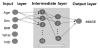
The performance on the test set was used for the data in Kiyosu city, Kyoto city, Taki-county and Uji city. The final inspection of the model was used for the data in Nagakute city (prediction system test). Accuracy represents the proportion of correct predictions among all the predictions made. To reduce the amount of data, we discarded those datasets with missing values.
Criterion for evaluation
The modes of MMSE, MoCAJ, and grip strength were decided according to medical criteria using minimal clinically important difference (MCID), and the range of the correct answer was <3.0, <2.0 and 6.0 respectively. The range of the correct answer for SMI (<1.0) and WHQOL (<0.6) was decided originally by referring to the basic information (average, valiance, standard deviation) and the tendencies in the relationships between MCID and MMSE, MoCAJ and grip strength.
Results
Study subjects
The characteristics of the study subjects are shown in Table 1. Obesity was defined as a BMI of ≥25.0 kg/m2. The prevalence of obesity determined by BMI was 21.4 – 28.0 kg/m2. This showed that it was similar to the mean for all 65 - 74-year-old Japanese (21.5 – kg/m2) 24.9 [8]. Serum 25OHD was classified as normal (>30 ng/ ml), insufficient (>20 to 29.9 ng/m), or deficient (<20 ng/m). In the subjects of this study, the level was either deficient or insufficient.
Performance measures for the deep learning algorithms
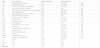
We applied machine learning and deep learning algorithms to predict MMSE, grip strength, SMI and WHQOL. Table 2 shows the results provided by the algorithm. This system showed more than 70% accuracy except for MoCAJ. SMI was correctly predicted in 92.1% and 93.8% of test sets and validation sets, respectively; MMSE was correctly predicted in 78.9% and 87.5% of test sets and validation sets, respectively.
The data in Table 2 showed that the model is a useful tool that will aid nurses in clinical decision-making processes for Japanese elderly.
Discussion
We developed and validated a novel predictive tool based on baseline demographics data. Our study suggests that age, sex, BMI, %Fat and serum VitD were associated with MMSE, grip strength, SMI and WHQOL. The results for MoCAJ did not come up to our expectations. There is a possibility that the ability of the person making the judgments may have had an impact. As a result of testing the suitability for the design of a two-stage classifier (<26 points (normal) or >25) using the same system, the accuracy of the test and validation data were 56.3% and 89.5%, respectively. The predictive function improved, but the result was still ungratifying. In the measurement of MoCAJ, individual variations and valuational change seem to be complicated. The addition of more learning data or an overall review of the prediction model are also needed.
Dementia is more commonly detected in elderly, and there has been an increase in the use of various treatments over the past 20 years. Consistent with this, our prediction model suggests that careful attention is needed with regard to meals, especially the consumption of meat and fish containing protein and VitD. Low VitD has been associated with a risk of developing sarcopenia [12, 13]. In this study, SMI could be correctly predicted in 92.1% of cases. The majority of elderly people showed relatively low overall frailty scores (mean: 5.44). In an earlier study, community-dwelling older adults were found to have relatively high QOL assessment values and relatively low overall frailty scores [14]. These results indicate that this model is useful in predicting sarcopenia and social frailty.
In a previous study, we showed that 25OHD supplementation was associated with improved VitD levels and possibly improved 4-m gait speed [15]. These facts indicate the need to adopt active sunbathing and to exercise at day-care services or other institutions in order to maintain VitD and muscle weight.
It is possible to stabilize the fluctuation of the predictive performance by reducing the number of input features to 5 from 6. These results suggest that the amount of input data needs to be regulated in consideration of a useable amount of data for machine learning. Although we only used a small number of cases, the inaccuracies with the algorithm were satisfactory for the prediction task. Thus, our findings should be able to serve as a foundation for larger prospective studies.
Conclusion
By combining 5 features (age, sex, BMI, %Fat and serum VitD), an algorithm with good predictive accuracy for maintaining cognitive and physical function and QOL was constructed. This algorithm could serve as a tool to aid nurses in clinical decision‐making processes.
Competing Interest
The authors declare that they have no competing interests.
Author Contributions
Dr. Hasegawa was responsible for the study conception, design, interpretation of data, and drafting of the
manuscript.
Dr. Tsuchiya was responsible for the machine learning approach and checking the manuscript.
Mr. Tsubouchi was responsible for data acquisition and checking the manuscript.
Dr. Yamada was responsible for
data acquisition and checking the manuscript. Dr. Shimizu was responsible for data acquisition and checking
the manuscript.
Ms. Kato was responsible for data acquisition and checking the manuscript Ms. Mochizuki was responsible for
data acquisition and checking the manuscript.
References
- Ferri CP, Prince M, Brayne C, Brodaty H, Fratiglioni L, Ganguli M, et al. (2005) Global prevalence of dementia: a Delphi consensus study. Lancet 366: 2112-7. View
- Prince M, Bryce R, Albanese E, Wimo A, Ribeiro W et al. (2013) The global prevalence of dementia: a systematic review and metaanalysis. Alzheimer's & Dementia 9: 63-75. View
- LeCun Y, Bengio Y, Hinton G (2015) Deep Learning. Nature 521: 436-444. View
- Saravi B, Zink A, Ülkümen S, Couillard-Despres S, Hassel F et al. (2022) Performance of artificial intelligence-based algorithms to predict prolonged length of stay after lumbar decompression surgery. J Clin Med 11: 4050- 4063. View
- De Ramón Fernández A, Ruiz Fernández D, Prieto Sánchez MT (2022) Prediction of the mode of delivery using artificial intelligence algorithms. Comput Methods Programs Biomed 219: 106740-106746. View
- Rostami M, Oussalah M (2022) A novel explainable COVID-19 diagnosis method by integration of feature selection with random forest. Inform Med Unlocked 30: 100941-100963. View
- Jia Y, Chang CH, Hughes TF, Jacobsen E, Wang S. et al. (2020) Predictors of dementia in the oldest old: A novel machine learning approach. Alzheimer Dis Assoc Disord 34: 325-332. View
- Folstein MF, Folstein SE, McHugh PR (1975) “Mini-mental state”. A practical method for grading the cognitive state of patients for the clinician. J Psychiatr Res 12:189-198. View
- Nasredding ZS, Phillips N., Bédirian V, Charbonneau S, Whitehead V, et al. (2005) The Montreal Cognitive Assessment, MoCA: a brief screening tool for mild cognitive impairment. J Am Geriatr Soc 53: 695-699. View
- Harmin EK, Gustafsson G, Jaracz K (2012) Quality of life among the elderly with locomotor disabilities in Sweden and Poland in the 1990s. Qual Life Res 21:281–289. View
- Kriegeskorte N, Golan T (2019) Neural network models and deep learning. Curr Biol 29: R231-R236. View
- Chang WT, Wu CH, Hsu LW, Chen PW, Yu JR et al. (2017) Serum vitamin D, intact parathyroid hormone, and Fetuin A concentrations were associated with geriatric sarcopenia and cardiac hypertrophy. Sci Rep 7: 40996. View
- Kupisz-Urbanska M, Płudowski P Marcinowska-Suchowierska E (2021) Vitamin D deficiency in older patients-Problems of sarcopenia, drug interactions, management in deficiency. Nutr 13: 1247-1257. View
- Papathanasiou IV, Rammogianni A, Papagiannis D, Malli F, Mantzaris DC et al. (2021) Frailty and quality of life among community-dwelling older adults. Cureus 13: 13049-13057. View
- Hasegawa N, Mochizuki M, Kato M, Shimizu N, Yamada T (2018) Vitamin D3 supplementation improved physical performance in healthy older adults in Japan: A pilot study. Health 10: 1200-1209. View